
NASA’s Psyche Mission: An Unprecedented Exploration of a Metallic Asteroid
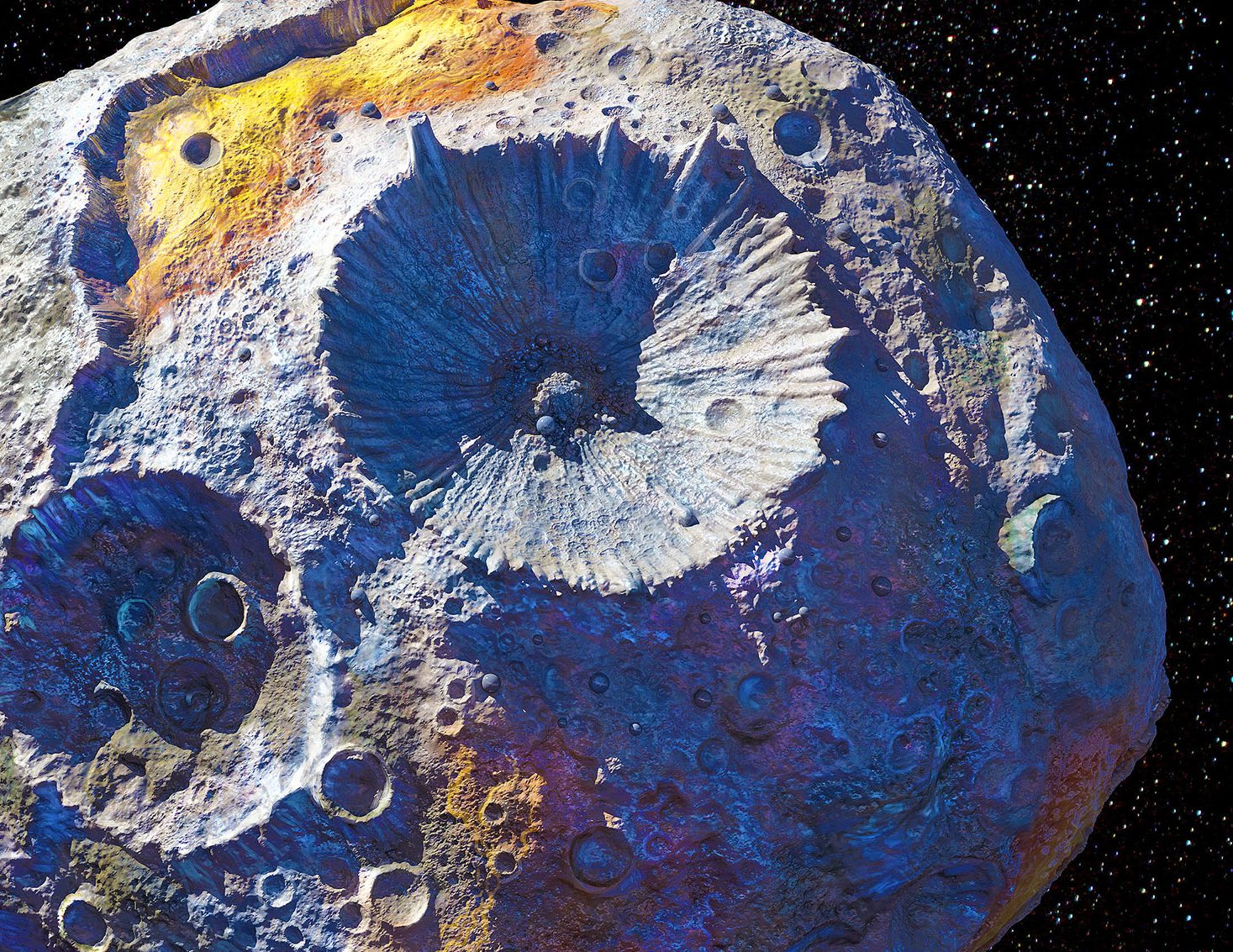
In June 2025, NASA has taken a significant step forward in expanding the boundaries of human knowledge with its innovative “Psyche Mission.” This mission aims to explore the metallic asteroid 16 Psyche, located in the main asteroid belt between Mars and Jupiter. Scientists believe this asteroid may be the core remnant of an ancient planet or planetesimal destroyed by repeated collisions. Launched on October 13, 2023, via a SpaceX Falcon Heavy rocket, the mission is slated to enter the asteroid’s orbit in August 2029. Today, we delve into the mission’s importance, the asteroid’s unique characteristics, and the potential benefits for humanity.
The Mystery of the Psyche Asteroid
16 Psyche is a rare metallic asteroid, approximately 226 kilometers in diameter, primarily composed of nickel and iron. Researchers suggest it could be the exposed core of a primordial planet that lost its mantle and crust due to collisions. With a density ranging from 3,400 to 4,100 kilograms per cubic meter—far higher than typical asteroids—Psyche is a subject of intense study. The Psyche Mission’s primary goal is to analyze its composition, chemical makeup, and magnetic field, offering insights into planetary formation history.
NASA’s research indicates that Psyche’s surface contains not only metallic elements but also silicate minerals, suggesting it may not be entirely metallic. The presence of hydrated silicates, likely deposited from collisions with smaller asteroids, highlights the asteroid’s diverse surface, fueling excitement for further exploration.
Mission Technology and Planning
The Psyche Mission, managed by NASA’s Jet Propulsion Laboratory (JPL), employs cutting-edge technology. It uses solar-electric propulsion via Hall-effect thrusters, enabling long-distance travel through space. Additionally, the mission will test Deep Space Optical Communications, a breakthrough that could shape future space missions. The spacecraft will perform a gravity assist near Mars in 2026 before reaching Psyche’s orbit in 2029.
The spacecraft will orbit Psyche in four distinct phases (Orbits A, B, C, D), ranging from 709 kilometers to 75 kilometers above the surface. Equipped with instruments like a magnetometer, multispectral imager, and gamma-ray/neutron spectrometer, it will map the asteroid’s structure and chemical composition. This data will help scientists understand the formation of Earth-like planets’ cores.
Significance for Humanity
The Psyche Mission holds multiple implications for humanity. Firstly, it will enhance our understanding of planetary formation. If Psyche is indeed an ancient core, it could reveal details about Earth’s core evolution. Secondly, its metallic resources—nickel and iron—could pave the way for future space mining, potentially benefiting space transportation and technology. However, the practicality of such mining remains a distant prospect.
Moreover, the mission’s success in testing new technologies will guide future space explorations. The asteroid’s unique surface and data could inspire new theories about the solar system’s history, enriching scientific knowledge.
Challenges and Hopes
The mission faces several challenges. Recently, a pressure drop in the propulsion system has been noted, which engineers are addressing with a backup solution. Additionally, Psyche’s distance and complex surface pose research difficulties. Nevertheless, NASA’s team is optimistic about overcoming these hurdles and completing the mission on schedule.
Conclusion
The Psyche Mission represents a giant leap for humanity. Beyond exploring an asteroid, it will deepen our understanding of the solar system’s origins and evolution. In 2029, as the spacecraft enters Psyche’s orbit, we will for the first time closely examine a metallic asteroid. The findings could illuminate the formation of Earth and other planets while shaping humanity’s future in space. This mission is a testament to our relentless pursuit of knowledge.
References:
- https://science.nasa.gov/solar-system/asteroids/16-psyche/ (Information on the asteroid’s characteristics and composition)
- https://science.nasa.gov/mission/psyche/ (Mission planning, technology, and timeline)
- https://theskylive.com/psyche-info (Data on the asteroid’s size and discovery)
- https://agupubs.onlinelibrary.wiley.com/doi/full/10.1029/2021JE007091 (Surface diversity and silicate presence)